 Call us now

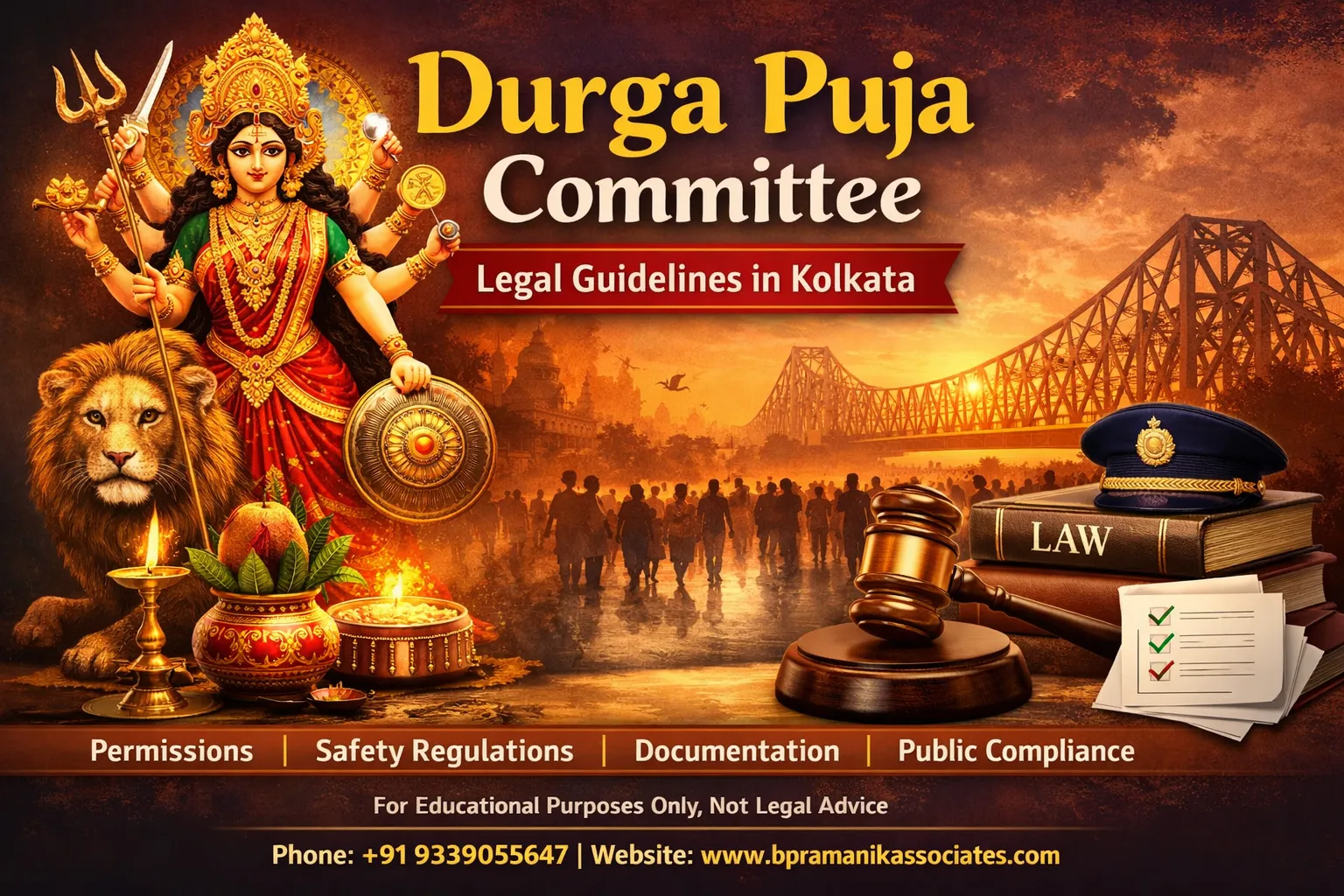
Durga Puja Committee Registration: Legal Guide for Puja Organizers

Durga Puja Committee Registration Introduction
Durga Puja is not just a festival—it is an emotion, a community gathering, and occasionally a logistical marathon involving lights, bamboo structures, enthusiastic volunteers, and the mysterious disappearance of the treasurer when donation collection begins. Behind the cultural celebration lies an important legal aspect that often receives less attention: proper organizational structure and regulatory compliance.
Understanding the legal framework surrounding Durga Puja Committee Registration helps organizers manage finances responsibly, coordinate activities smoothly, and operate within applicable laws. This article explains the legal background, documentation, and procedural considerations involved in organizing such committees within the Indian regulatory environment.
The purpose of this guide is purely educational, explaining legal structures and compliance responsibilities associated with community organizations.
Understanding the Legal Nature of Durga Puja Committees
Durga Puja committees typically function as community organizations formed by local residents, clubs, or cultural groups. While many begin informally—often with a few enthusiastic neighbors and a notebook for donations—formal recognition helps establish transparency and governance.
In India, cultural committees are often structured under legal frameworks such as:
- Society registration structures
- Public charitable trusts
- Non-profit associations
Each structure carries certain administrative responsibilities, including record maintenance, financial transparency, and internal governance procedures.
For community festivals like Durga Puja, society registration is frequently considered suitable because it allows multiple members to collectively manage activities, finances, and decision-making processes.
A registered structure also helps define accountability, particularly when donations, sponsorships, or community funds are involved.
Legal Framework Governing Cultural Committees
India does not have a single statute dedicated exclusively to festival committees. Instead, such organizations typically operate under general non-profit legal frameworks.
Common legislative references include:
- Society registration laws governing non-profit associations
- Trust laws applicable to charitable institutions
- Local administrative regulations issued by municipal authorities
- Public safety and event permissions issued by district administration
These laws regulate aspects such as organizational governance, financial recordkeeping, and public safety compliance.
Local authorities may also require permissions relating to:
- Temporary structures and pandals
- Public gatherings
- Traffic management
- Noise control regulations
- Fire safety certifications
Therefore, legal compliance extends beyond registration and may involve multiple administrative approvals depending on the scale of the event.
Basic Structure of a Puja Committee
A typical Durga Puja committee includes members assigned specific responsibilities. While practices vary across regions, a standard organizational structure may include:
President
Vice President
Secretary
Assistant Secretary
Treasurer
Executive Members
These positions help distribute responsibilities and maintain internal governance.
For example, the treasurer typically handles financial records, donation accounts, and expenditure documentation. The secretary generally manages meeting records, correspondence, and administrative communication.
Although these roles may sound very formal, in many localities they are filled by the same neighbors who also supervise decorations and ensure the bhog distribution queue remains peaceful.
However, once funds are involved, formal roles help ensure accountability.
Documents Typically Required for Committee Formation
Formal organization often requires documentation establishing the identity and governance structure of the committee.
Common documentation may include:
Memorandum describing the objectives of the organization
Rules and regulations governing committee operations
Identity and address proof of founding members
Address proof of the organization’s registered office
List of governing body members
Minutes of the founding meeting
The memorandum generally explains the purpose of the organization, which in this context may include organizing cultural events, religious festivals, and community welfare activities.
Rules and regulations define membership criteria, meeting procedures, voting rights, and financial oversight.
These documents help create a transparent governance framework.
Governance and Financial Transparency
Community festivals often involve donations from residents, local businesses, and supporters. With financial contributions comes responsibility.
Proper financial management may include:
Maintaining donation records
Preparing annual financial statements
Keeping expense receipts and invoices
Maintaining bank accounts in the committee’s name
Documenting committee resolutions regarding expenditures
Transparent financial records protect committee members from potential disputes or misunderstandings regarding funds.
Even small committees may benefit from basic accounting practices.
And yes—this may include the careful tracking of funds spent on lighting arrangements that appear to consume half the budget but still look spectacular.
Permissions and Local Administrative Compliance
Organizing public events typically requires coordination with local administrative authorities. Requirements may vary depending on the location and scale of the celebration.
Authorities may require:
Police permission for public gatherings
Traffic management coordination
Fire safety clearance for temporary structures
Municipal permissions for pandal construction
Electrical safety compliance
Local guidelines are usually issued prior to the festival season.
Committees are encouraged to review these instructions carefully to avoid regulatory complications.
Such approvals are intended primarily to ensure public safety rather than restrict cultural celebrations.
Community Responsibility and Public Safety
Durga Puja celebrations often attract large gatherings. Safety considerations therefore become important for organizers.
Committees may adopt practices such as:
Crowd management planning
Emergency exits in pandals
Proper electrical wiring
Fire extinguishers at event sites
Coordination with emergency services if required
These measures contribute to a safe environment for visitors.
Although the festival atmosphere is joyful and energetic, safety planning helps ensure celebrations remain smooth and secure.
Cultural and Social Significance
Durga Puja is widely regarded as one of the largest community festivals in eastern India. Beyond religious rituals, it includes cultural programs, art installations, music performances, and food distribution.
Committees often serve broader social functions by organizing:
Cultural competitions
Community meals
Charitable activities
Educational programs
Local development initiatives
As a result, many committees evolve into long-term cultural organizations that operate beyond the festival season.
Formal organizational structures support such long-term activities by providing continuity and governance.
Record Maintenance and Administrative Responsibility
Once established, committees may maintain records for operational continuity.
Common records include:
Meeting minutes
Financial registers
Membership records
Donation registers
Annual activity reports
These documents help maintain transparency and institutional memory.
For example, next year’s committee members will appreciate knowing why the previous committee ordered 300 kilograms of khichuri when the expected crowd was only 200 people.
Documentation ensures that institutional knowledge is preserved.
Regulatory Awareness and Ethical Governance
Community organizations benefit from awareness of legal responsibilities and ethical governance principles.
These may include:
Responsible use of public funds
Transparency in financial dealings
Respect for public safety regulations
Cooperation with local authorities
Adherence to applicable legal provisions
Responsible governance strengthens public trust and helps sustain community traditions.
Durga Puja committees play an important cultural role, and maintaining compliance ensures the continuation of these celebrations within lawful frameworks.
Conclusion
Durga Puja celebrations represent a remarkable blend of culture, art, devotion, and community participation. While the festival spirit often focuses on creativity and celebration, the organizational side benefits from proper legal structure and administrative awareness.
Understanding the regulatory environment helps committees operate transparently and responsibly.
Legal organization also encourages structured governance, financial accountability, and community confidence.
In practical terms, this means that behind every beautifully illuminated pandal stands a group of dedicated individuals balancing tradition with compliance—while still finding time to enjoy the festival itself.
Author & Institutional Information
Advocate B Pramanik & Associates is a legal practice engaged in professional work relating to legal documentation, regulatory compliance, criminal law procedure, civil and property drafting, corporate and business documentation, NGO and trust compliance, taxation-related submissions, and intellectual property documentation, along with representation before competent courts, tribunals, and statutory authorities in accordance with the Advocates Act, 1961 and applicable professional standards.
Office Addresses
Salt Lake Office:
First Floor – 211, SDF Building, Sector V, Salt Lake City, Kolkata – 700091, West Bengal, India
Rajarhat Office:
First Floor – 1C, Reckjoyani More, Rajarhat Enclave, Rajarhat Main Road, Kolkata – 700135, West Bengal, India
(By Appointment only)
Dum Dum Office:
264, Private Road, Dumdum, Kolkata – 700074, West Bengal, India
Available on Sunday and by prior appointment.
Professional Communication
Phone: +91 9339055647 (WhatsApp) | +91 6291661951 (WhatsApp)
Email: info@bpramanikassociates.com
Website: www.bpramanikassociates.com
Professional Disclaimer
This article is published strictly for educational and informational purposes only. The content does not constitute legal advice, advertisement, solicitation, or inducement. Viewing this material or communicating through this platform does not create an advocate–client relationship. All professional work is undertaken in accordance with the Advocates Act, 1961 and the rules prescribed by the Bar Council of India.