 Call us now

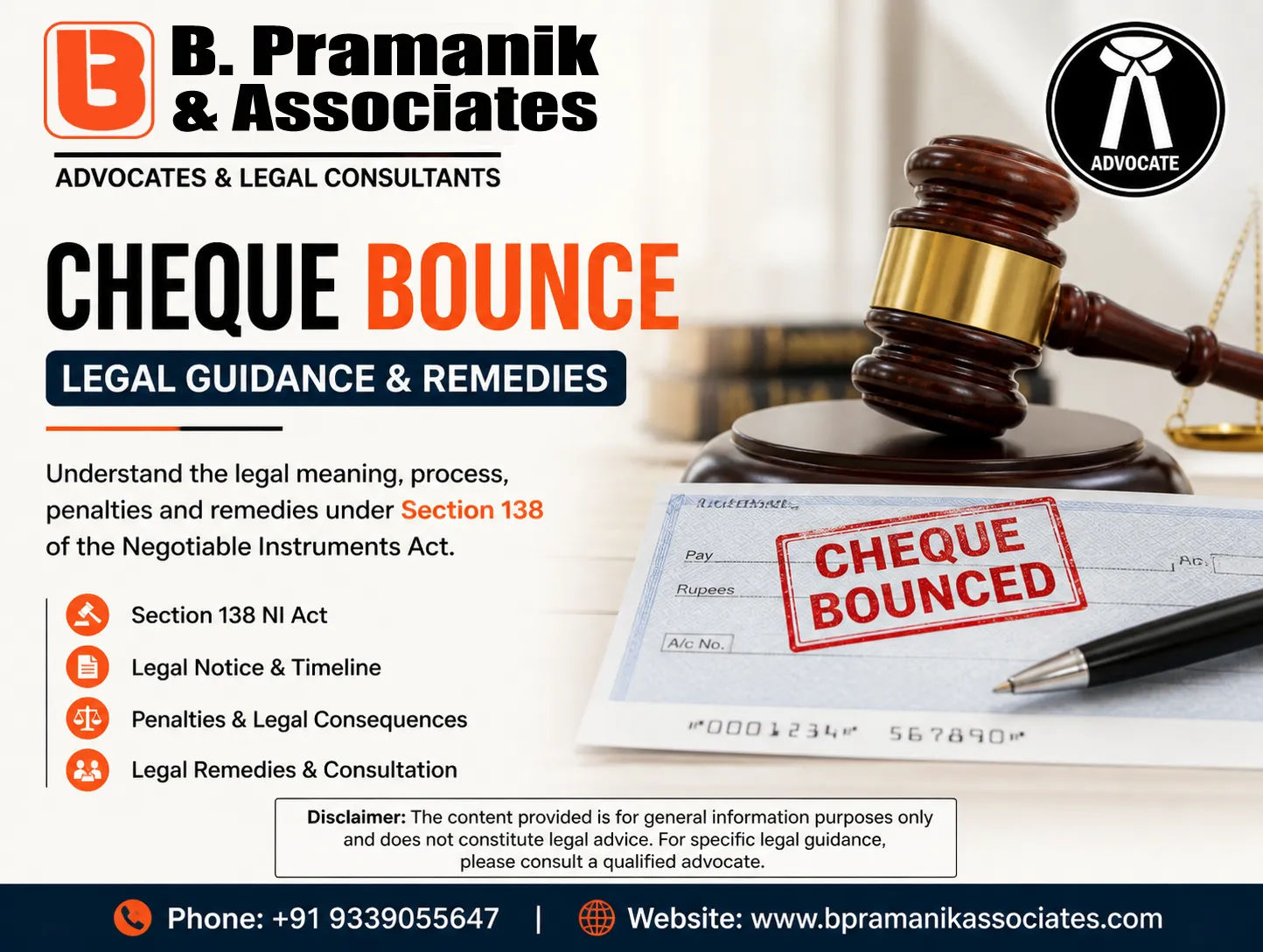
Cheque Bounce: Legal Meaning, Process & Remedies in India

Introduction
A cheque bounce is a common financial issue that can lead to significant legal consequences in India. It occurs when a bank refuses to process a cheque due to insufficient funds, signature mismatch, or technical errors.
Under the Negotiable Instruments Act, 1881, particularly Section 138, cheque dishonor is treated as a serious legal matter. This blog provides structured legal guidance and consultation-level understanding of legal remedies, helping readers understand their rights and responsibilities in such cases.
What is Cheque Bounce?
A cheque bounce (also known as a dishonoured cheque or returned cheque) occurs when the bank is unable to honour a cheque presented for payment.
Common reasons include:
- Insufficient funds in the account
- Signature mismatch
- Overwriting or alterations
- Stale cheque (older than 3 months)
- Post-dated cheque presented early
- Account closure or freezing
From a legal perspective, cheque bounce becomes actionable when it is linked to a legally enforceable debt or liability.
Common Reasons for Cheque Dishonor
1. Insufficient Funds
The most frequent cause where the drawer’s account does not have enough balance.
2. Signature Mismatch
Banks verify signatures strictly, and any discrepancy may result in dishonour.
3. Stale Cheque
Cheques presented after three months from the date of issue are invalid.
4. Post-Dated Cheque
A cheque presented before the mentioned date will not be processed.
5. Overwriting or Corrections
Unverified changes may lead to rejection by the bank.
6. Account Closed or Frozen
If the account is inactive or restricted, the cheque will not be honoured.
Legal Consequences Under Section 138
The cheque bounce provisions under Section 138 of the Negotiable Instruments Act establish criminal liability.
Key consequences include:
- Criminal Liability: Dishonour due to insufficient funds or stop payment attracts legal action
- Imprisonment: Up to two years
- Fine: Up to double the cheque amount
- Summary Trial: Faster disposal by Magistrate Courts
This provision aims to ensure financial discipline and trust in commercial transactions.
Cheque Bounce Case Process in India
Understanding the legal timeline is essential for both the complainant and the accused.
Step 1: Receipt of Cheque Return Memo
The bank issues a memo stating the reason for dishonour.
Step 2: Sending Legal Notice (Within 30 Days)
The payee must send a written demand notice within 30 days from receiving the memo.
Step 3: 15-Day Waiting Period
The drawer is given 15 days to make the payment after receiving the notice.
Step 4: Filing Complaint (Within Next 30 Days)
If payment is not made, a complaint can be filed before the Magistrate.
Step 5: Court Proceedings
The case proceeds through summons, evidence, and final judgment.
Cheque Bounce Legal Notice Requirements
A valid legal notice is a mandatory requirement before initiating legal proceedings.
Important elements include:
- Details of the cheque
- Reason for dishonour
- Demand for payment within 15 days
- Date of issuance of notice
Failure to issue a proper notice may affect the maintainability of the case.
Documents Required for Legal Action
The following documents are typically required:
- Original cheque
- Cheque return memo
- Copy of legal notice
- Postal receipts or proof of delivery
- Evidence of debt (agreement, invoice, etc.)
These documents establish the basis of the legal claim.
Legal Remedies Available
A cheque bounce case allows multiple legal remedies depending on the situation.
1. Criminal Proceedings
Initiated under Section 138 for penal consequences.
2. Civil Recovery Suit
Filed separately to recover the cheque amount.
3. Settlement Between Parties
Parties may resolve the dispute amicably at any stage.
Legal consultation is advisable to determine the appropriate course of action.
Settlement of Cheque Bounce Cases
Cheque bounce cases are compoundable, meaning they can be settled with mutual consent.
Key points:
- Settlement can occur before or during trial
- Court approval is required for closure
- Settlement may reduce litigation time and costs
What to Do If You Receive a Legal Notice
If you are the drawer of a bounced cheque, the following steps are important:
Step 1: Review the Notice Carefully
Check details such as amount, cheque number, and claims.
Step 2: Respond Within 15 Days
Failure to respond may lead to legal proceedings.
Step 3: Consider Settlement
Resolving the matter early may prevent escalation.
Step 4: Seek Legal Consultation
Understanding your legal position is essential before responding.
Bail in Cheque Bounce Cases
Cheque bounce offences are bailable and compoundable.
Bail process includes:
- Appearance before the Magistrate
- Filing a bail application
- Submission of bail bond and surety
- Court approval of bail
Courts generally grant bail upon compliance with procedural requirements.
When Section 138 Does Not Apply
Certain situations may fall outside the scope of criminal liability:
- Cheques issued as gifts
- Cheques issued as security without enforceable liability
- Absence of a legally enforceable debt
Each case depends on specific facts and documentation.
Informational Subtopics for Better Understanding
Cheque Bounce Legal Process in India
Covers notice issuance, waiting period, and complaint filing.
Section 138 NI Act Rules
Defines liability, punishment, and procedural requirements.
Cheque Bounce Notice Time Limit
Specifies 30-day notice period and 15-day payment window.
Penalty for Cheque Bounce
Includes imprisonment, fine, and legal costs.
Frequently Asked Questions
What is the penalty for cheque bounce?
Up to two years imprisonment or fine up to double the cheque amount, or both.
What is the time limit for sending a legal notice?
Within 30 days from receiving the cheque return memo.
Can a cheque bounce case be settled?
Yes, it is compoundable and can be settled with mutual agreement.
Is cheque bounce a criminal offence?
Yes, under Section 138 of the Negotiable Instruments Act.
Is bail available in cheque bounce cases?
Yes, it is a bailable offence.
Conclusion
A cheque bounce involves both financial and legal implications under Indian law. The provisions of Section 138 of the Negotiable Instruments Act establish a structured mechanism for addressing such disputes.
Understanding the legal process, documentation, and timelines is essential for effectively handling cheque dishonour cases. Whether acting as a complainant or responding as an accused, timely action and proper legal consultation can help ensure compliance with the law and resolution of the dispute.
Professional Communication related to Cheque Bounce Case
Advocate B Pramanik & Associates is the office of Advocate Banshidhar Pramanik, based in Kolkata, providing legal services in matters relating to documentation, compliance, and advisory within the framework of applicable laws.
The office is situated at Rajarhat Location: First Floor – 1C, Rajarhat Residency, Reckjoyani More, Rajarhat Main Road, Kolkata – 700135, West Bengal, India and Salt Lake Sector V Location: Office of the Banshi Advocates at First Floor – 211, SDF Building, Sector V, Salt Lake City, Kolkata – 700091, West Bengal. For professional communication, the office may be contacted at +91 9339055647 or via email at info@bpramanikassociates.com. Further informational details are available on the website www.bpramanikassociates.com.
Office working hours are generally observed from Monday to Saturday between 10:30 AM and 7:00 PM, with the office remaining closed on Sundays.
This information is provided strictly in compliance with the rules of the Bar Council of India. It is intended for informational purposes only and does not constitute any form of advertisement, solicitation, or legal opinion.